
How might we create a tactile product experience that supports cognitive stimulation and emotional bonding for dementia families?
Sensory Interaction Tool for Dementia Care
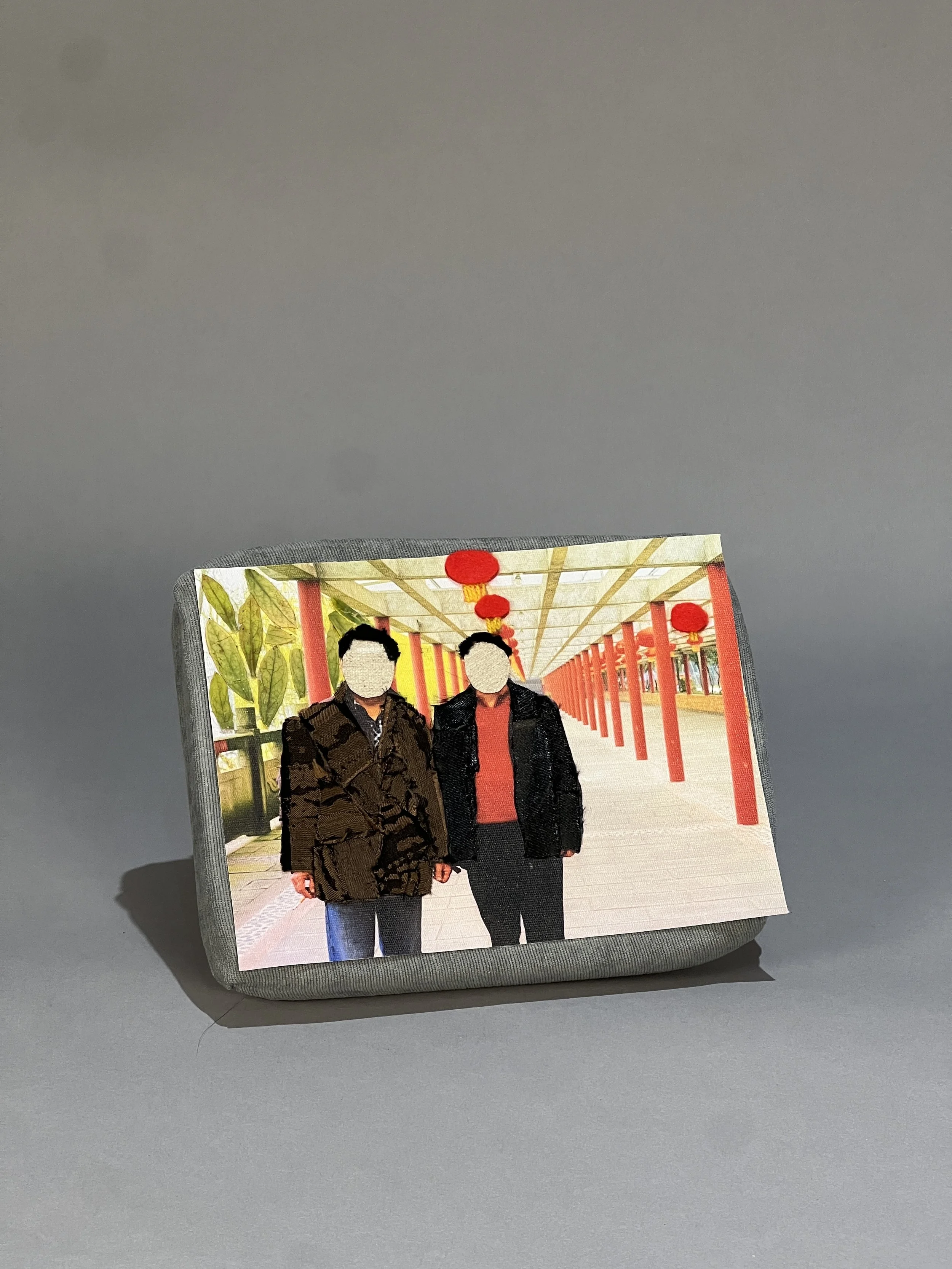
Memory Mat
Introduction
Memory Mat is a sensory-based cognitive construction product for Dementia families. Memory Mat promotes a novel way of relationship between patients and caregivers, diagnosed elderly and kindred younger generation.
Designed with the perspective of viewing Dementia patients as naive kids, it evokes empathy to the patient's situation and strengthens emotional connections.
Role
UX/UI Designer, UX Researcher
Aug 2023 - Dec 2023
This is an independent project out of personal interests.
Methods
Research: Literature Review, Survey, Field Studies, User Interview, Five-second Testing, Competitive Analysis
Tools: Arduino, Processing, Photoshop, Artificial Intelligence Animation, Premiere Pro, Textile Design
Approach
The rationale of the Memory Mat is a combination of multiple therapies, featuring Reminiscence Therapy and Montessori Education Method.
Through the sensory interaction with a material collage adapted from the real old photo, the patient would re-construct their memory with family members, improving both the individual well-being and family connections.
Team: Nitin Chatlani, Daniel Self, Cindy Liu Jiayi

PRELUDE
Family Inspiration
The Memory Mat began as a deeply personal project.
My grandfather was diagnosed with cerebral ischemia and Alzheimer’s disease at age 80. One afternoon, my young cousin found an old family photo album, and to our surprise, it sparked vivid memories. My grandfather began sharing stories and even remembered his best friend, Mr. Yuan, who had passed away years earlier. That moment revealed how tactile, familiar materials could reignite emotional and cognitive connections.
Social Observation
This personal experience echoed a broader social issue. The documentary Life Matters (人间世) portrayed similar moments of reconnection: one patient sang along every time a wartime song played, reliving his days as a soldier.
These insights shaped my design goal: to create an interactive sensory experience that helps people with memory loss reconnect with their past and loved ones, promoting dignity, emotional comfort, and shared storytelling.
DESIGN CONCEPT
Research Insights
User & Caregiver Challenges
Patients often face frustration and dependency, leading to loss of autonomy and self-esteem.
Patients need sensory and emotional engagement, not only cognitive exercises, to feel fulfilled.
Family caregivers struggle with emotional fatigue and role reversal.
Family relationships deteriorate as communication break down. Children fear future diagnosis.
Existing Therapy Approaches
Reminiscence Therapy – recalling personal memories through photos or music.
Simulated Presence Therapy – using familiar voices and recordings to reduce anxiety.
Reality Orientation & Sensory Stimulation – grounding patients through sensory cues and environment.
Montessori-based Activities – tactile, simple tasks that rebuild confidence through guided independence.
Design Opportunities
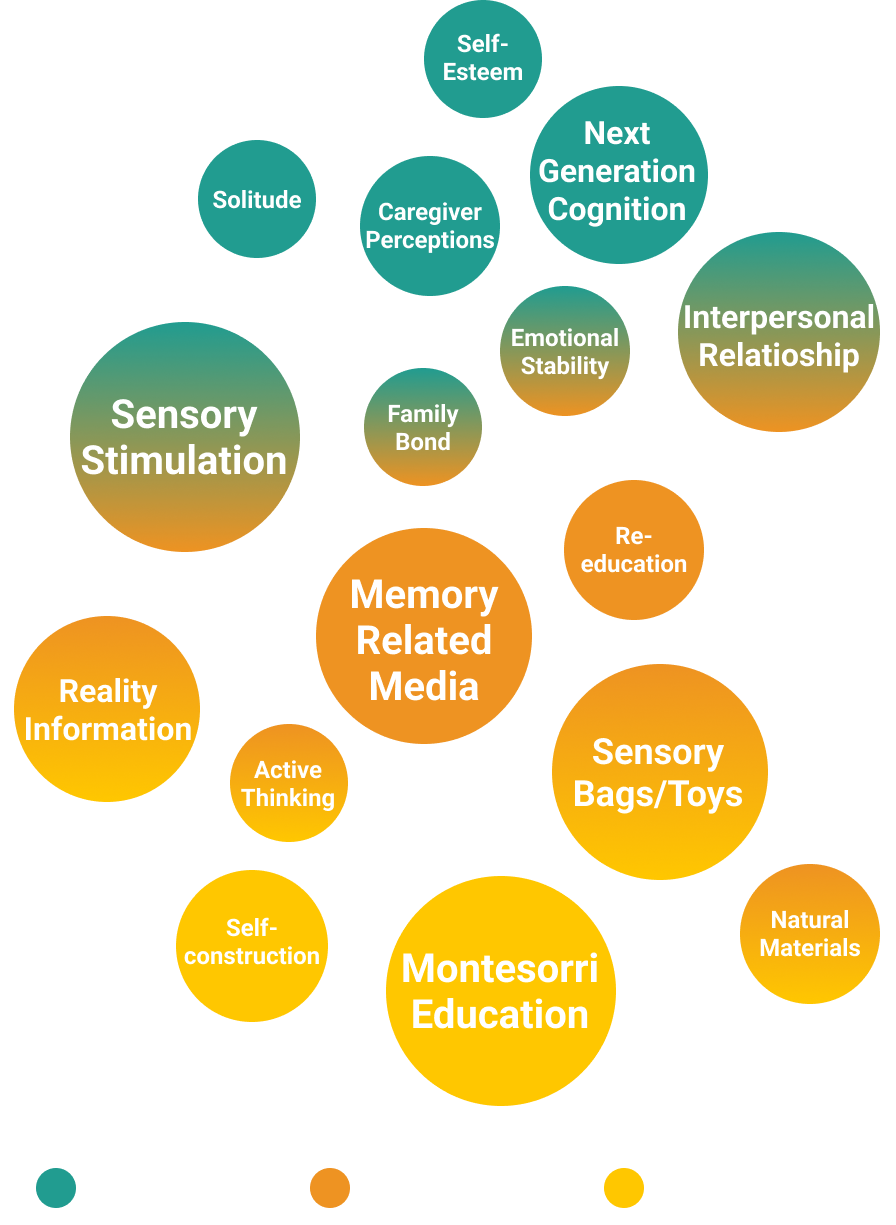
People with dementia often go through a kind of cognitive regression, similar to early childhood learning. By drawing from Montessori education, we can design experiences that bring back a sense of independence, curiosity, and joy through tactile and sensory engagement. This idea became the foundation of the Memory Mat, a design that uses touch, memory, and empathy to reconnect people with their loved ones.
Affinity Mapping
TARGET USER STUDIES
Field Studies
Present user with old photo albums and observe without intervention.
Interviews
Ask open-ended questions about old photos, memories, and feelings.
Five-second Testing
Describing prompt product flows in storytelling, collect immediate reactions.

Recall forgotten events
Hard to find himself in group photos
Frequent touching and pointing gestures
Environment and detailed object reliance
Passionate introduction to others
I don’t remember everything, but I know it was a good time.
I think I can recall some of my old friends. We must have been close.
😊
😢
🤔
Love the idea of having something to hold in hand.
Deeply touched to see an old friend come to life again in any form.
Wonder how to use this “high-tech“ product.

Need guidance to recognize his relatives
Interested in resemblance between relatives
Kept the same viewing pace with grandpa
Took a mirror to compare himself and his father
Grandpa and daddy all looked so different back then. It’s very fun.
I wish I can have a big photo album too.
🤔
😁
Wonder what materials would be used.
Excited to see people in a photo moving.
CONCEPT SKETCHING

Material-Photo Collage Cushion
Print the photo on a canvas, and sew/tape four kinds of materials to the according sensory section of the photo.
Attached: Corduroy, Nylon, Chinese Lantern Sampling, Tree Leaves
Base: Photo-printed canvas
Force Sensitive Resistors
Using combination of round-shape and square-shape Force Sensitive Resistor (FSR) under the photo-printed canvas, each attached to according sensory section.
by adafruit
Arduino Uno & Breadboard
Utilizing the Serial Communication between Arduino and Processing to achieve the cross-media response.


PRODUCT MECHANISM


USER FLOW

Set Up

Detailed Elements Reconstruction
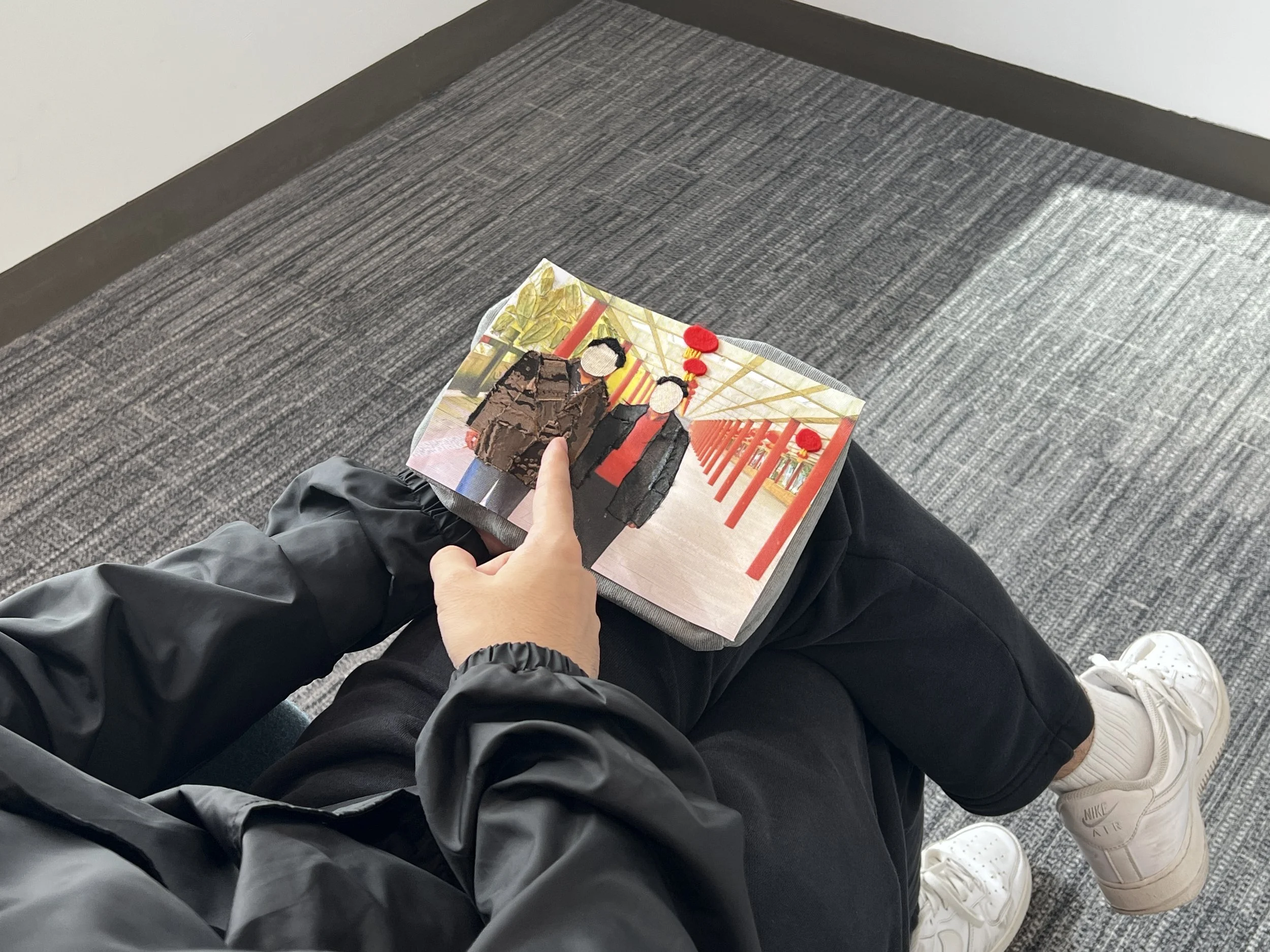
Touch and Get Familiar

Characters Image Reconstruction
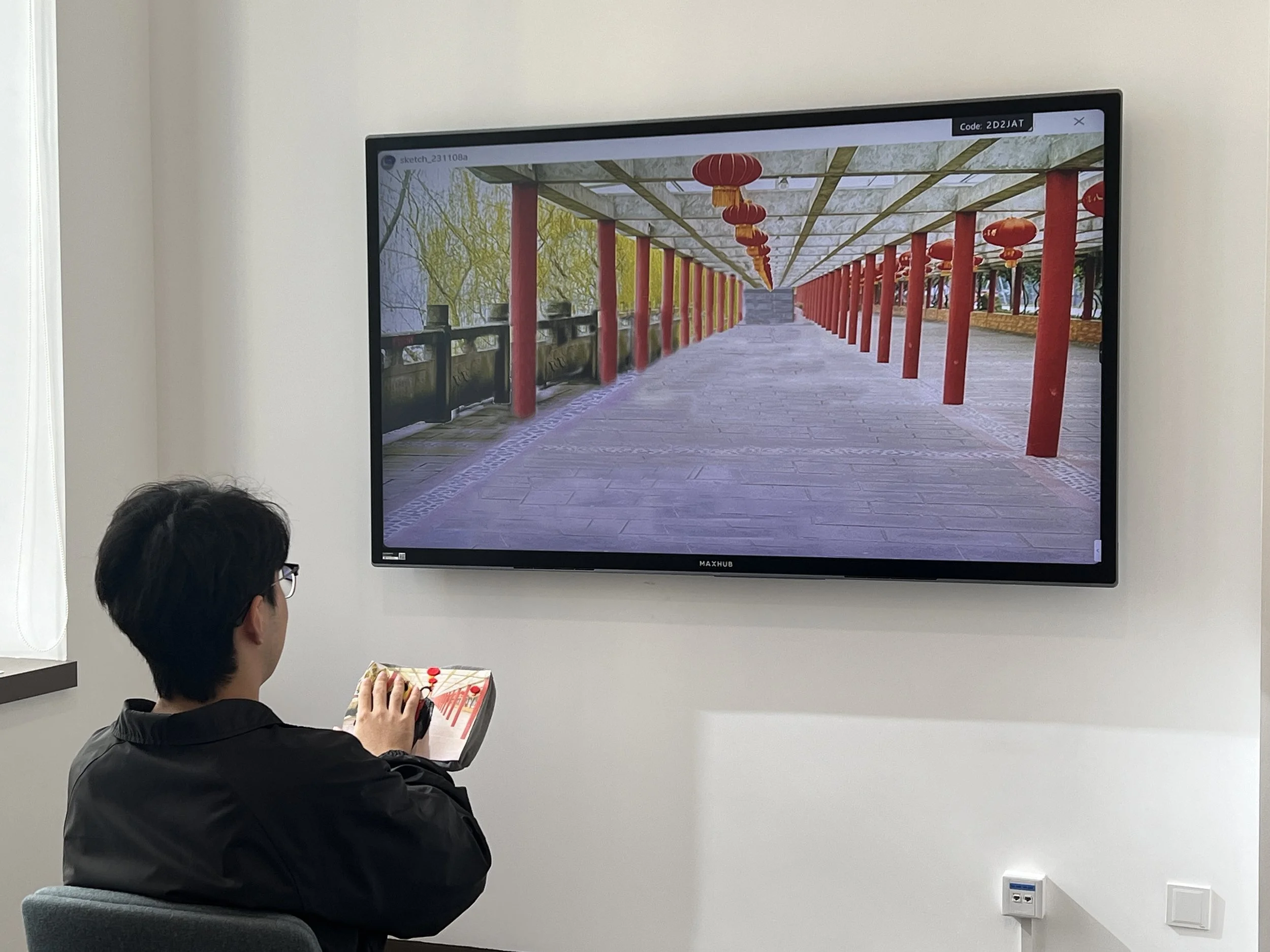
Photo Scene Reconstruction

Repeated Touch for Animation
OPEN SOURCE
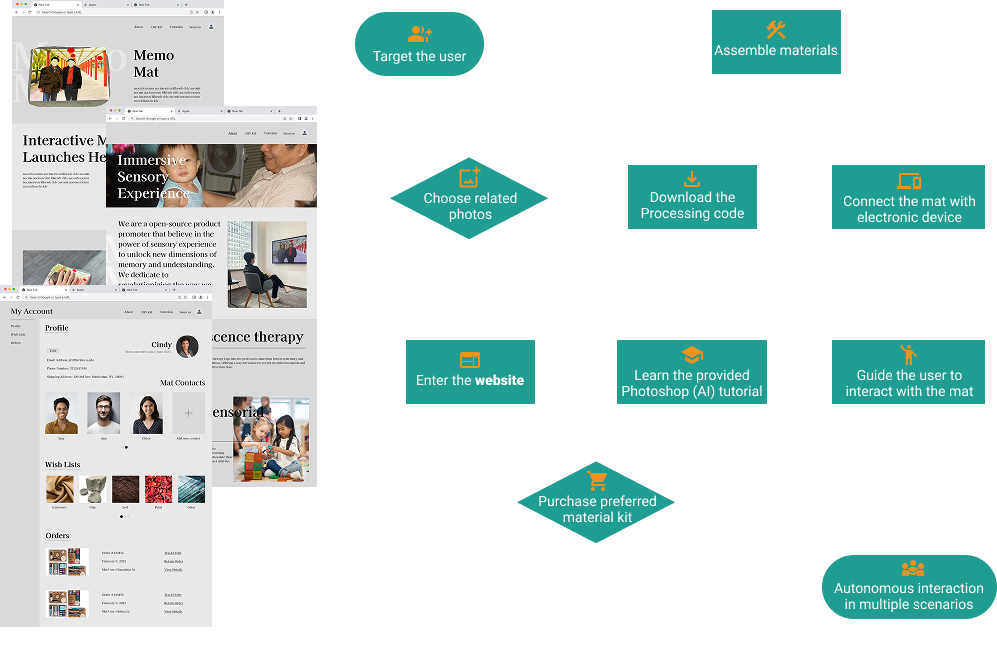
I designed an open-source system to scale the Memory Mat from concept to market. Through a guided web platform, users can upload photos, customize material kits, and download code and tutorials to build their own mats.
This model lowers production barriers, enables community-driven iteration, and positions the product for accessible, decentralized adoption in therapeutic and home settings.
FUTURE INSIGHTS
Sensors
Medium


Mass Production and Upcycling


